

Table of Contents
This guide compares colander vs strainer, explaining their design, hole size or mesh differences, common uses, and material options. You will learn when to reach for each tool, how to maintain them, and practical buying tips so you can pick the right drainware for everyday cooking tasks and specific recipes with confidence.
Design and anatomy of colanders and strainers
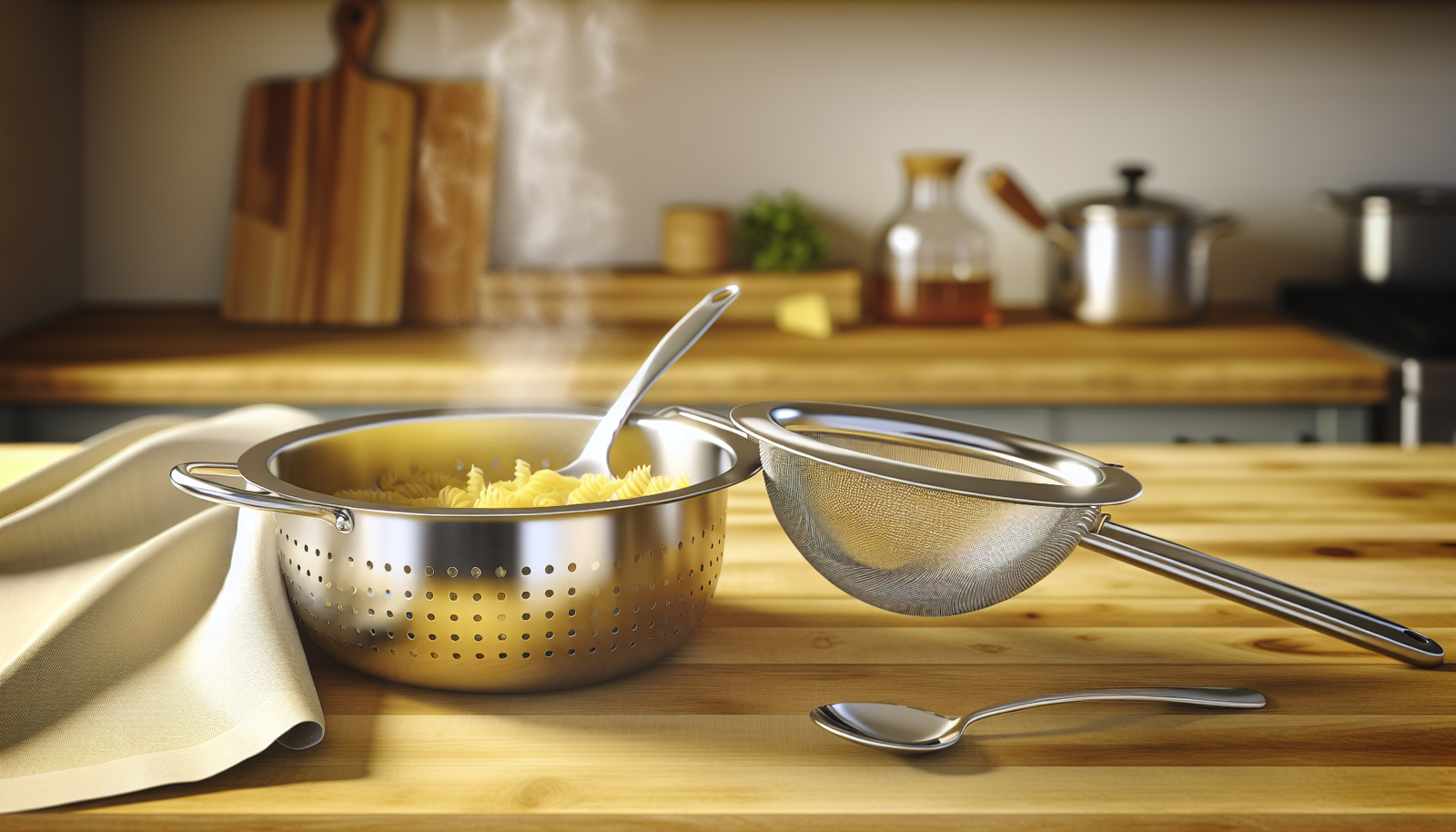
A colander is a bowl-shaped kitchen tool with holes or perforations throughout its sides and bottom, designed primarily for draining water from larger food items such as pasta, vegetables, or fruit. In contrast, a strainer is typically a fine mesh tool—often conical or flat—that separates finer solids from liquids or sifts dry ingredients. The essential difference between colander and strainer lies in their mesh size and the scale of food they’re designed to handle: colanders are for draining bulkier foods, while strainers handle smaller particles or liquids.
Physically, a colander is most often a deep, open bowl. Key characteristics include:
- Bowl Shape: Usually round, with high sides that allow for easy collection and draining of food.
- Perforations: Evenly distributed holes on the sides and bottom, typically ranging from 2 to 6 mm in diameter—large enough to let water flow but small enough to keep food in.
- Feet or Base: Some colanders have a pedestal base or feet to keep the tool lifted above the sink, allowing water to drain completely.
- Handles: Two side handles for stability and safe gripping.
- Materials: Commonly made from stainless steel, plastic, or silicone—each material affecting weight, durability, and ease of cleaning.
- Capacities: Colander sizes typically range from 1.5 to 5 quarts (about 1.5 to 5 liters), making them suitable for family-sized portions.
The colander’s relatively large, uniform holes make it ideal for quickly draining pasta or rinsing leafy greens—tasks where speed and capacity are preferred over fine filtration.
A strainer, on the other hand, is designed with finer filtration in mind:
- Shape: Usually cone-shaped (for chinois-style), hemispherical, or flat disc-shaped for sifting.
- Mesh: Made from woven or welded metal mesh, available in different grades from coarse to ultra-fine (measured in mesh count or microns – for example, a 200-micron mesh traps much finer particles than a 1 mm mesh).
- Rim and Handle: A sturdy rim holds the mesh in place; handles range from single long handles to two smaller grips for balanced use.
- Materials: Predominantly stainless steel wire, but sometimes nylon or silicone mesh for specific purposes.
Mesh strainers excel at strainer uses such as removing seeds from purees, sifting flour, or clarifying stocks—tasks where catching fine solids is critical.
Colander Anatomy Summary:
- Perforations
- Bowl body
- Feet or base
- Handles
Strainer Anatomy Summary:
- Mesh (wire or woven)
- Rim
- Handle(s)
From a manufacturing perspective, colanders use stamped or punched perforations in metal or molded holes in plastic, providing rigidity and making cleaning straightforward. Strainers rely on tightly woven mesh—this offers much finer filtration but requires greater care to prevent damage and thorough cleaning to clear trapped particles.
When each excels: Colanders shine at draining larger food quantities quickly. Strainers provide precision when you need to separate very small particles or achieve clarity in liquids—making the “colander vs strainer” distinction fundamental for efficient kitchen prep.
Hole size and mesh explained
A critical element in the colander vs strainer debate is the size and pattern of holes or mesh, which determines exactly what stays in and what drains out. The diameter of holes in a colander or the fineness of mesh in a strainer controls the flow of water, air, and particles—deciding whether you’ll keep pasta in the bowl or lose your basmati rice down the drain.
Colanders usually feature large, evenly spaced perforations, ranging from about 3 mm to as much as 8 mm in diameter. This “coarse” pattern moves water quickly and works well for draining chunky foods like pasta, boiled vegetables, or potatoes. Large holes allow full water evacuation, but can also let small items (like peas or grains) escape.
Mesh strainers, by contrast, vary far more in their fineness. “Medium mesh” often has about 1 mm openings and is woven from wires; it’s suitable for rinsing grains like rice or quinoa, where you want water out but grains in. “Fine mesh” or micron-level strainers can have mesh that traps even small seeds and fine particles. The fineness is measured in microns (μm), with typical chinois or conical strainers at 600–400 microns (ideal for stocks and sauces), while very fine tea strainers can drop below 200 microns, capable of filtering tiny tea leaves or sifting flour smoothly.
Distinct strainer types serve specific needs:
- Fine conical tea strainer: Small and very fine, ideal for filtering loose tea leaves or spices.
- Chinois: A cone-shaped, fine-mesh strainer (400–800 microns) often paired with a cloth liner for ultra-smooth soups or custards.
- Traditional sieve: Flat or round, available in coarse and fine meshes, great for sifting dry goods or separating pulp from juice.
When choosing between tools, match the job to these categories:
- Large perforations: draining pasta, rinsing salad greens, or washing root vegetables.
- Medium mesh: rinsing rice, quinoa, small beans—prevents grains slipping through, allows fast water drain.
- Fine mesh: straining sauces, stocks, custards, purees, or dusting flour and sugar.
Common confusion arises when a colander appears to work like a coarse strainer. A simple test is to pour a handful of rice or lentils into your tool: if any grains slip through with running water, the openings are too large for that task. Pour water with flour through a mesh: if “cloudy” water collects below, you need a finer mesh. You don’t need special equipment—just use typical kitchen ingredients to gauge whether your strainer or colander will keep everything you want inside. This hands-on approach can settle any doubt about which draining tool is fine enough for your kitchen job.
Everyday uses and cooking scenarios
Everyday kitchen tasks often hinge on the choice between colander and strainer—picking the right one is essential for efficiency, safety, and best results. Knowing which to use comes down to the food’s size, texture, and the result you’re after. Here is a scenario-driven guide:
- Rinsing salad greens:Colander—Large leaves need generous drainage holes and space.
- Place greens in the colander.
- Rinse under cold running water, tossing occasionally.
- Shake gently to remove excess water, then let rest for a few moments.
- Draining pasta:Colander—Sturdy structure and larger holes prevent pasta from escaping.
- Set colander in sink before pouring hot pasta in.
- Allow all water to drain; shake if needed.
- Transfer pasta safely with a spoon.
- Rinsing rice or quinoa:Fine-mesh strainer—Small grains slip through colanders.
- Pour grains into strainer.
- Hold strainer under running water, swishing grains gently.
- Tap strainer to remove excess water.
- Washing berries:Mesh strainer or fine-hole colander—Delicate and small.
- Gently place berries in the strainer.
- Rinse with cool water; let excess flow away.
- Rest strainer on a towel to drain completely.
- Sifting dry ingredients:Fine-mesh strainer—Keeps flour and sugar free of lumps.
- Spoon dry ingredients into strainer above a bowl.
- Tap or shake strainer gently.
- Straining stocks and sauces:Fine-mesh strainer—Removes fine particles for clarity.
- Place strainer over a large bowl or pot.
- Slowly pour liquid through; let it drain completely.
- Tap or stir for faster flow.
- Clarifying butter or making tea:Ultra-fine mesh or specialty tea strainer.
- Pour liquid slowly for best filtration.
- Use back of spoon to help push liquid through, if needed.
- If draining large or fragile solids (like boiled veggies or salad), use a colander.
- If you want to trap fine grains or particles and get clear liquids, use a fine or ultra-fine strainer.
- If the food is both bulky and fine (like broth with meat chunks), use both: first colander, then strainer.
Multi-step tasks maximize results. For example, when making a clear soup:
- Drain vegetables with a colander to separate large solids.
- Then pass the liquid through a fine-mesh strainer for clarity.
This approach ensures efficiency and an ideal texture for your finished dish.
Safety and Food Quality Tips:
- When draining hot items (like pasta), always use heat-resistant colanders, avoid steam burns, and stabilize the tool in the sink before pouring.
- If straining over a pot, use a strainer with a long handle for better leverage and to keep hands away from rising steam.
- For sticky foods (like rice), avoid shaking too vigorously to prevent breakage.
- Wash and dry tools thoroughly after use to avoid retained odors or flavors.
Choosing the right tool for your kitchen
**Choosing the right colander or strainer involves more than grabbing the first one you see. Think about how often you cook, the types of cuisine you enjoy, and your available kitchen space.** If you’re draining pasta once a week, a mid-sized colander will do. But if you regularly rinse grains, strain fine sauces, or bake frequently, varying mesh sizes and forms become crucial.
*Start with these main considerations:*
- Frequency of use: Daily users benefit from durable, easy-to-clean materials. Occasional cooks may favor lightweight or compact tools.
- Primary foods cooked: Pasta, vegetables, berries, and grains all require different mesh/fineness. Consider if you need fine mesh for small grains or robust holes for hearty vegetables.
- Storage space: Nesting sets or folding silicone colanders suit small kitchens. Sturdy single-piece models fit better in large drawers or with hanging storage.
- Material preferences: Stainless steel, plastic, and silicone each have pros/cons (see below).
- Dishwasher safety: Convenience matters—verify any labeling, especially for plastic and silicone.
- Heat resistance: For hot pasta or stocks, ensure your tool won’t warp (stainless and some silicone are best).
- Durability: Check welds, joinings, and overall rigidity. Flimsier options suffer over time.
- Budget: Quality strainers and colanders don’t have to be expensive, but ultra-cheap versions can disappoint with poor finishes or short lifespans.
*Recommended sizes and combos:*
- Single person or couple: One 2.5–3 quart colander, plus a 3- to 4-inch fine mesh strainer for grains or tea.
- Family of four: 5-quart colander for pasta/veggies and a set of 3/5/7-inch mesh strainers for versatility.
- Home chef or frequent entertainer: 1 large and 1 medium colander, plus three strainers (fine, medium, and coarse mesh, 3-7 inches wide).
*Materials and mesh type:*
- Stainless steel: Durable, resists staining/warping, dishwasher safe, strong against heat.
- Plastic: Lightweight, affordable, but may absorb odors or stain; can warp with hot foods.
- Silicone: Foldable for storage, heat tolerant, nonstick, but sometimes less rigid and pricier.
- Woven stainless mesh: Fine for sauces/grains, won’t rust; pricier but long-lasting.
- Cheap plated mesh: Prone to rust, damage, and chemical leaching—avoid if possible.
*Starter Kit Recommendation:* **At minimum, have one medium stainless-steel colander and two mesh strainers (one fine, one medium).** This covers everything from pasta and veggies to sifting flour, rinsing rice, or straining soup.
**Buying tips:** Always inspect for rough seams, strong and secure handles, and balance. **Red flags:** Flimsy mesh, bad odor, sharp edges, and seams where food might get trapped—these are hard to clean and shorten the tool’s lifespan.
*Choose wisely: matching your draining tools to your most-cooked recipes means faster, safer, and frustration-free cooking. Don’t be swayed by trending gadgets if they don’t fit your actual kitchen habits.*
Care maintenance and storage tips plus alternatives
-
- Cleaning best practices:
- Hand washing is ideal for both colanders and fine mesh strainers. Use warm soapy water and a soft-bristled brush to gently remove food debris, especially in mesh.
- Dishwasher safe? Many stainless steel and some plastic tools are dishwasher-safe, but check the manufacturer’s instructions. Fine mesh strainers may distort in a dishwasher, so hand wash when possible to maintain shape.
- Trapped food removal: Use a narrow brush, pipe cleaner, or wooden toothpick to free bits caught in holes, corners, or mesh. Always brush from the inside out on mesh to avoid tearing.
- Soaking sticky residues: Fill with hot water and a drop of dish soap, let sit 10–20 minutes. For tough starch or grease, a splash of vinegar or baking soda can help loosen buildup.
- Dry thoroughly: After rinsing, shake off extra water and air-dry completely on a rack. Storing while moist allows rust or mildew, especially on steel or woven mesh. For extra assurance, pat dry with a clean towel.
- Gentle ways to clean fine mesh:
- Swish the mesh in a bowl of warm soapy water, then rinse under running water while brushing gently.
- For oily or starchy deposits, create a paste of baking soda, massage onto the mesh with a soft toothbrush, then rinse thoroughly.
- Never scrub hard or twist the mesh, as this warps and can tear it. Avoid abrasive scrubbers.
- Common troubleshooting and fixes:
- Bent rim: Carefully reshape with your hands or a rubber mallet, providing gentle pressure.
- Torn mesh: Minor tears can allow food through; retire for uses not requiring fine filtration or safely replace when holes expand.
- Rust spots: Scrub gently with a baking soda paste. Persistent rust means replacement is best for food safety.
- When to replace: Severe warping, multiple tears, persistent rust, or plastic that has warped or cracked call for a new tool. Reliable draining and safety outweigh repair efforts here.
- Efficient storage ideas:
- Nesting: Place smaller strainers or colanders inside larger ones, but never force mesh into tight spaces where it can bend or dent.
- Hanging: Use hooks or a wall-mounted rod to store colanders/strainers by their handles, keeping mesh clear of contact.
- Stacking order: Store mesh strainers above or beside heavier colanders to avoid crushing.
- Space-saving hybrids: Collapsible or fold-flat designs are useful in smaller kitchens and protect mesh during storage.
- Alternatives and complementary tools:
- Salad spinner: Great for washing and drying leafy greens; less efficient for hot foods.
- Chinois (conical sieve): Fine purees and velvety sauces, excels in professional or advanced home kitchens.
- Food mill: Perfect for sauces or mashed foods needing separation of skins/solids.
- Fine mesh sifter: Sifting dry ingredients like flour or powdered sugar.
- Coffee filter or cheesecloth: For ultra-fine filtration, such as broths or nut milks where even mesh strainers aren’t fine enough.
- Maintenance Checklist (copy, print, or screenshot)
- Inspect for damage each wash and dry promptly
- Hand wash mesh whenever possible
- Clean stuck food with fine brushes or toothpicks
- Soak to loosen stubborn residues
- Store with protection for mesh—hang, nest carefully, or use collapsible
- Replace if mesh tears, rust persists, or rims cannot be bent back safely
- Consider adding specialty tools (salad spinner, chinois, food mill) if your recipes demand them
- Cleaning best practices:
Conclusions
Colanders and strainers serve distinct but complementary roles: colanders for rapid draining of large solids and strainers for trapping fine particles and clarifying liquids. For most kitchens the best approach is a small set covering coarse to fine tasks. Choose materials and sizes that match your cooking habits, follow simple maintenance steps to extend life, and combine tools when recipes demand precision.
For more products reviews click here.